Building or upgrading a dock in Murrells Inlet sounds simple until you hit the rules. You want easy boat access and a clean design that respects the marsh. This guide shows you who approves docks, whether your lot qualifies, how big you can build, what to submit, and how long approvals really take. Let’s dive in.
Who approves docks in Murrells Inlet
- State: The South Carolina coastal program (often called OCRM) is the primary decision maker for private docks in tidelands and coastal waters. Start with the state’s critical area guidance and forms for docks and minor activities. Review OCRM’s minor permit guidance.
- Federal: The U.S. Army Corps of Engineers, Charleston District, may also need to verify your project under Section 10/404. Many small docks qualify under Nationwide Permits. Check the USACE Charleston Regulatory page.
- Local: Georgetown County may require land disturbance and stormwater approvals if you move soil upland, and an encroachment permit if work affects a county right of way. See the land disturbance permit page.
Do you qualify for a private dock
Waterfront status and frontage
To qualify as a private dock under coastal rules, your upland parcel must meet the state definition of waterfront property or be part of a subdivision with a preapproved Dock Master Plan. For lots subdivided after May 23, 1993, plan on at least 75 feet of marsh-edge frontage and 75 feet between extended property lines at the dock location. Joint or community docks often reduce the per-lot frontage to about 50 feet. See OCRM’s minor activities overview.
Subdivision Dock Master Plans
Some Murrells Inlet communities use Dock Master Plans that set dock corridors and eligibility. Always check HOA documents and state records for an approved plan that may shape placement and spacing. Read the state’s coastal permitting FAQ.
Size and design limits that drive your plan
Creek width controls square footage
State guidance uses marsh-grass-to-marsh-grass creek width to cap total dock area. For private, recreational docks, typical limits are:
- Creeks ≤ 10 ft: no dock allowed.
- Creeks < 20 ft: generally no dock allowed. If a rare exception applies, structures are limited to 50 sq ft and no boatlifts or storage platforms.
- Creek width 20–50 ft: maximum 120 sq ft.
- Creek width 51–150 ft: maximum 160 sq ft.
- Creek width >150 ft: maximum 600 sq ft.
All fixed pierheads, floating docks, roofs, boatlifts, davits, and storage platforms count toward the cap, and lifts are not allowed on very narrow creeks. See OCRM’s minor permit guidance.
Other design rules to note
- Maximum length: docks longer than 1,000 feet over the critical area are prohibited.
- Handrails: height is limited to 36 inches above decking.
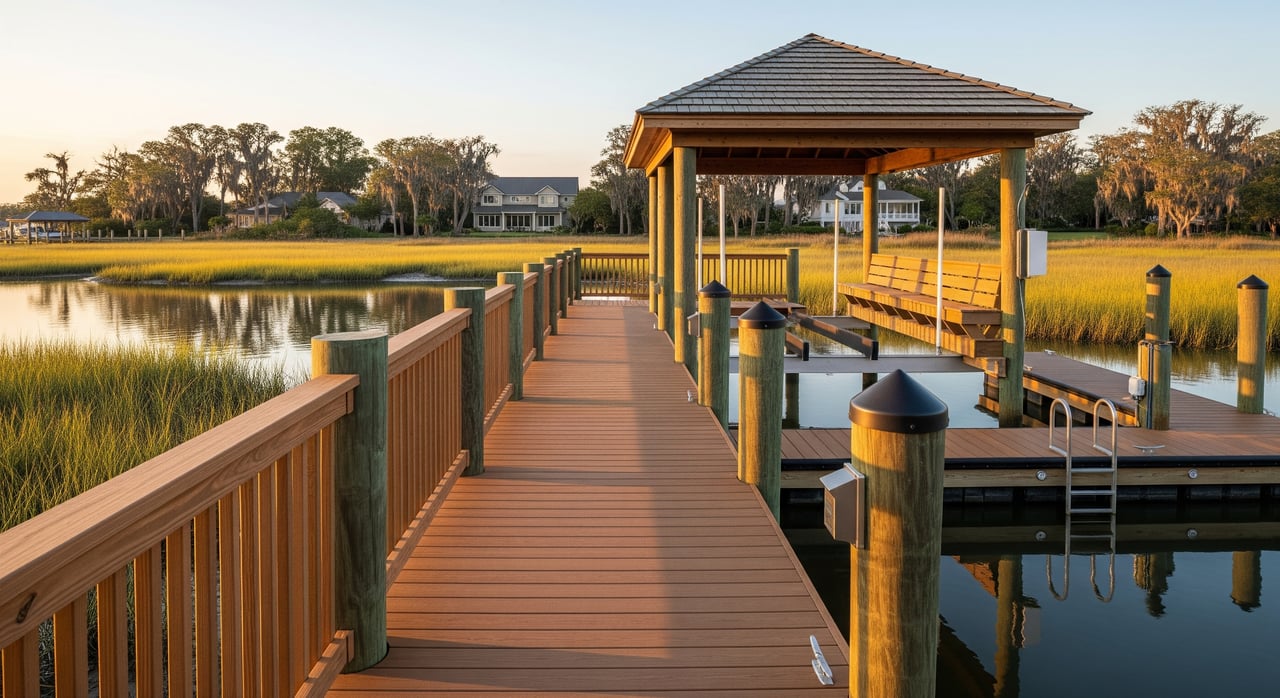
- Enclosures: no walls or screened rooms on docks; roofs over pierheads may be reviewed case by case.
- Alignment: docks generally extend to the first navigable creek within your corridor unless site factors justify another approach. Review South Carolina Regulation 30-12.
Permit types and required documents
State critical-area permits
- General Permit for docks: often used for qualifying additions or minor docks that meet set conditions. Administrative fee is commonly $100.
- Minor permit: for most private docks; fees typically $150 for docks 100 feet or less and $250 for over 101 feet.
- Major permit: marinas, community docks, dredging, or ramps fall here and have higher fees and longer review. Explore state permit categories and conditions in the state’s program pages for general permits and minor activities.
Federal authorization
Many small private docks are verified under USACE Nationwide Permits. Some require a preconstruction notification, and others need an individual permit if they do not fit NWP conditions. Start with the Charleston District Regulatory page.
What to include in your application
State reviewers expect complete, professional submissions:
- Stamped drawings by a South Carolina licensed surveyor, engineer, or landscape architect.
- Location map, plan and profile views, dimensions, and creek width measurement method.
- Public notice materials: certified mail receipts to adjacent owners and a newspaper ad affidavit.
- Fees and any required federal forms. Find the state’s checklist and submittal expectations in the minor activities guidance.
Public notice and neighbor communication
For new critical-area permits, OCRM runs a 15-day public notice. Amendments are usually 10 days. You must send certified mail to adjacent owners and place a local newspaper notice, then submit proof to the state before a permit is issued. Details and timing rules are outlined in the state’s general permit procedures.
Realistic timelines in Murrells Inlet
Best case for a simple dock
- Plan prep and survey: about 2–4 weeks, depending on consultant availability.
- State review and notice: minimum ~3 weeks total, which includes OCRM’s 15-day notice and administrative handling.
- Federal layer, if needed: Nationwide Permit verification often runs 45–60 days from a complete federal submittal, usually concurrent with state review. When everything is aligned and complete, a realistic shortest path is 6–10 weeks from complete submission.
When it takes longer
Expect 2–4 months in common scenarios that need minor revisions or added documentation. Projects with dredging, shoreline stabilization, public objections, endangered species or historic reviews, or individual USACE permits can take 6–12+ months, and the state notes that some permits can take up to a year. See the state’s timing guidance on how long permitting may take and USACE’s overview of Nationwide Permit processing.
Key timing tips
- Submit complete, stamped drawings and all notice proofs the first time.
- Coordinate state, federal, and county submittals in parallel when advised.
- Confirm whether a USACE preconstruction notification is required before you submit, to avoid rework.
Step-by-step checklist
- Confirm eligibility: waterfront status, 75-foot frontage rule, and any Dock Master Plan that sets corridors.
- Hire a SC-licensed surveyor or engineer for stamped drawings and square footage calculations.
- Confirm federal needs with USACE Charleston; prepare any preconstruction notification.
- Prepare public notice: certified mail to adjacent owners and a newspaper ad with affidavit.
- File the state application through the e-permitting portal with the correct fee.
- Coordinate county land disturbance or encroachment permits if upland work or access affects county property. See county guidance and encroachment permits.
- Pick up and post the Construction Placard if required. General permits often require construction within one year of issuance. Longer permits typically expire in five years unless extended.
Costs to plan for
- State application fees: General Permit about $100; minor permits often $150–$250 depending on length; major permits are higher.
- Professional services: survey, stamped drawings, and engineering typically fall in the low thousands for a small private dock application package.
- Local fees and construction: county permits add cost, and build-out pricing varies by length, materials, and site conditions.
Murrells Inlet and Georgetown County specifics
- Land disturbance and stormwater: If you are grading or working near water, you may need county stormwater approval and a Land Disturbance Permit.
- Encroachment: Any work within a county right of way requires a county encroachment permit.
- Dock Master Plans: Many subdivisions around Murrells Inlet use DMPs that define dock corridors. Check HOA records and state files early.
Planning your dock alongside these rules helps you avoid redesigns and delays. If you are buying, selling, or building on the Grand Strand and want a modern, rental-savvy waterfront strategy, connect with Jack Chazen for a private conversation.
FAQs
What frontage do I need for a private dock in Murrells Inlet?
- For lots subdivided after May 23, 1993, plan on about 75 feet of marsh-edge frontage and 75 feet between extended property lines; joint or community docks typically reduce per-lot frontage to about 50 feet.
How big can a private dock be on a narrow Murrells Inlet creek?
- The state caps total dock area by creek width: none for ≤10 ft creeks, limited or none for <20 ft, then 120 sq ft for 20–50 ft, 160 sq ft for 51–150 ft, and up to 600 sq ft for >150 ft, with lifts counted toward the cap.
How long do approvals usually take for a simple private dock?
- With complete plans and parallel reviews, expect about 6–10 weeks at the fastest and 2–4 months in common scenarios; complex projects can run 6–12+ months.
Do I need a federal USACE permit for a Murrells Inlet dock?
- Many small docks are verified under Nationwide Permits with a possible preconstruction notification, but projects that do not fit NWP conditions may require an individual permit through the USACE Charleston District.
What documents should I include with my OCRM application?
- Submit stamped drawings, a location map, plan and profile, creek width method, certified-mail receipts to adjacent owners, a newspaper affidavit, fees, and any federal forms required.
Are roofs, boatlifts, or storage platforms allowed on private docks?
- Lifts and platforms count toward total dock area and are not allowed on very narrow creeks; roofs over pierheads may be considered, but walls and screens are not permitted under state rules.